
I was browsing the Firefox site a few hours ago, checking the release notes for an update, when I ran into a banner that made me smile. One of those slightly bitter smiles—the kind you give when you find out your favourite vegan restaurant is owned by a fast-food chain.
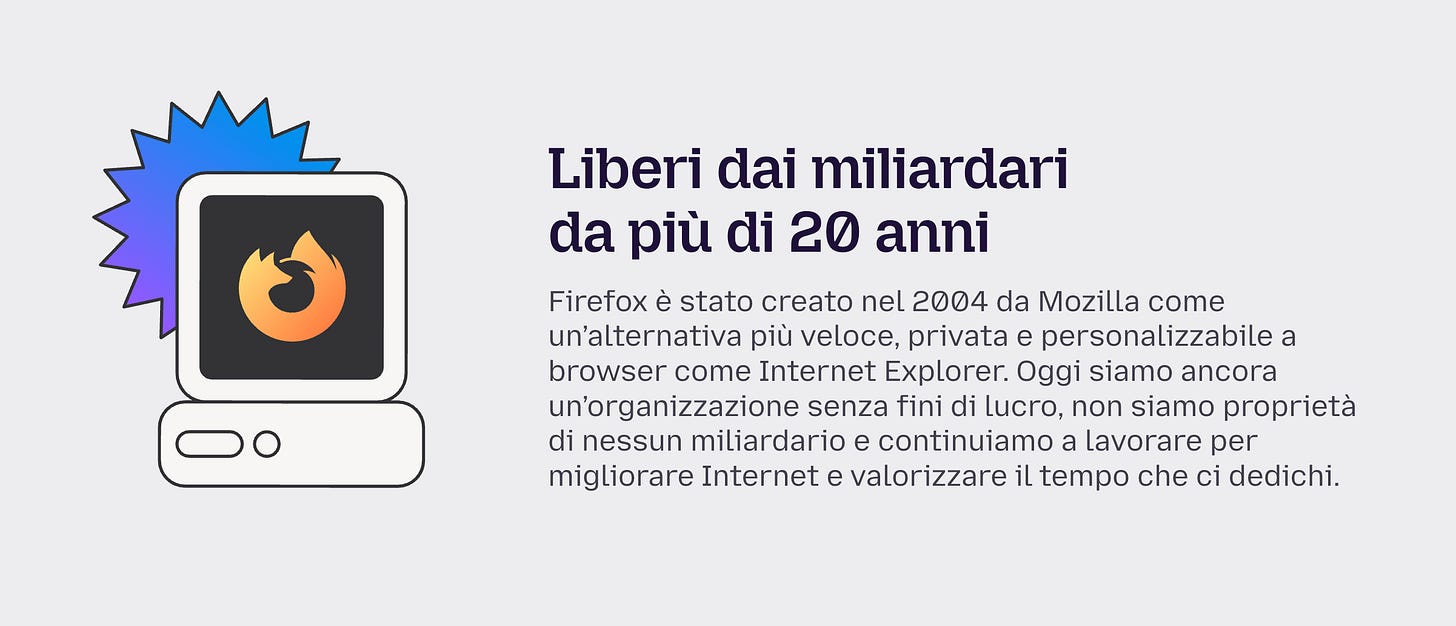
The Banner
“Free from billionaires for over 20 years,” reads the text next to the red panda logo. And below: “We’re not owned by any billionaire and we keep working to make the Internet better and respect the time you spend on it.”
Lovely. Really lovely. Pity the reality is a little more nuanced.
Because Mozilla does have a glorious history. Firefox was born as a free, open source alternative back when Internet Explorer dominated the web with its suffocating monopoly. For years it was the browser of purists, of tinkerers, of anyone who believed in a more open and privacy-respecting internet. In some ways, it still is.
But let’s talk money, because in the end money is what keeps even non-profit foundations running.
The Numbers
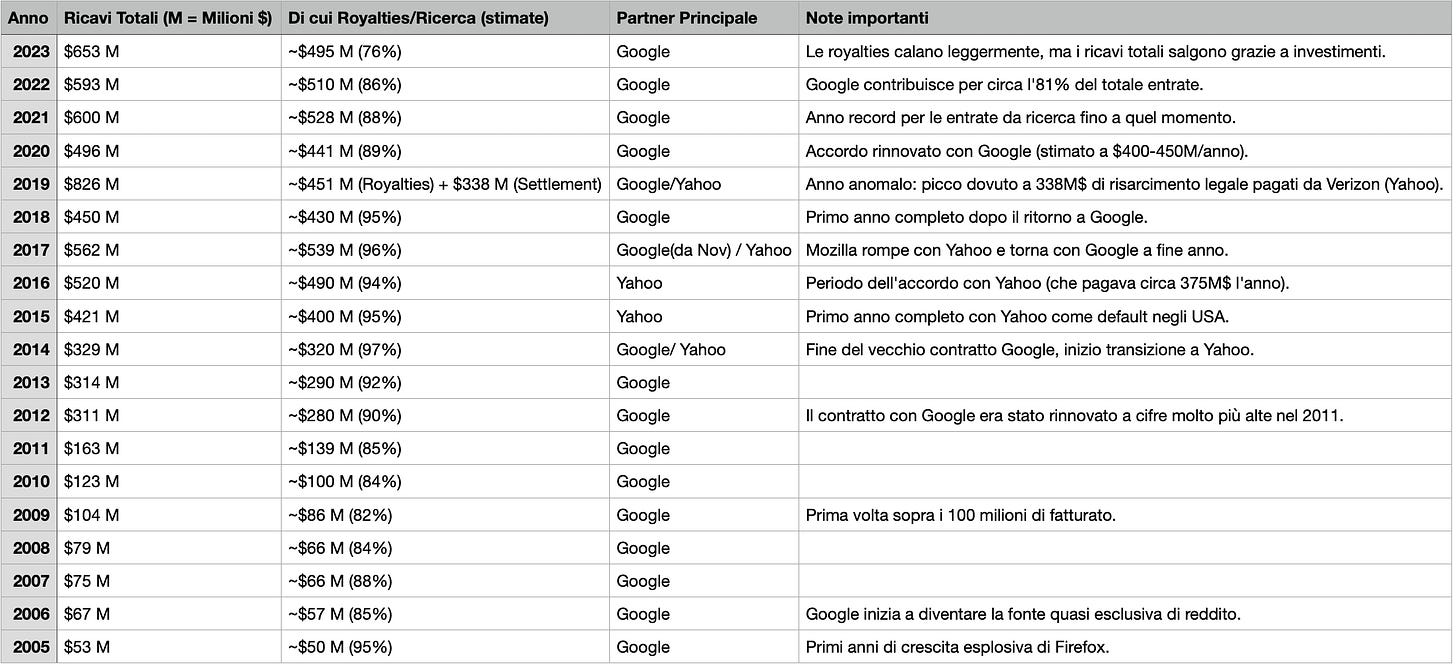
In 2023 Mozilla took in around $653 million. A respectable figure. Of that, roughly $495 million (76%) comes from royalties for the default search engine. And who pays those royalties? Google. Yes, that Google—the one that belongs to Alphabet, whose market cap is over $2 trillion. Google, founded by Larry Page and Sergey Brin, both well past the billionaire threshold.
The fun part is that this isn’t a recent anomaly. From 2005 to today, with a brief Yahoo interlude between 2015 and 2017, Google has consistently covered between 80% and 90% of Mozilla’s budget. Always. For twenty years.
Twenty Years of Dependence
Look at the historical trend and the dependence is striking. In 2005, when Firefox was in the middle of its explosive growth, Google royalties already represented 95% of revenue. In 2012, after the contract was renewed, the numbers got much higher. In 2020, the deal was renewed with estimates between $400 and $450 million a year.
There’s an odd data point in 2019: revenue jumped to $826 million. Not because of any particular Mozilla achievement. That year Verizon (which had bought Yahoo) had to pay $338 million in damages for breaking the partnership contract early. So even when Mozilla wasn’t depending on Google, its bottom line ended up depending on another tech giant.
The Antitrust Alibi
And the most interesting part? Even though Firefox’s market share has been in steady decline for years, revenue has stayed stable or even grown. Why? Because for Google, even a reduced number of Firefox users using its search engine is worth the investment. It’s an elegant way to avoid monopoly accusations. Being able to say “look, an alternative exists and we support it financially” comes in handy when antitrust regulators are giving you the side-eye.
I’m not saying Mozilla is evil or hypocritical. It isn’t that simple. Mozilla does important work: it builds a browser that respects user privacy more than Chrome does, contributes to open web standards, funds interesting projects in security and ethical AI.
But that banner. That banner makes me laugh a little.
“Free from billionaires” while your salary comes from a multi-million-dollar contract with one of the richest companies on the planet. It’s a bit like a tenant paying rent to a real-estate magnate boasting about having nothing to do with rich people.
The difference between being owned by a billionaire and being financially dependent on one is subtle, sure. Technically true. But also a little intellectually dishonest.
The real problem isn’t even the creative marketing. The real problem is the fragility of a business model built on a single customer. What happens if Google decides not to renew the contract? What happens if antitrust authorities crack down on these deals? What happens if Chrome becomes so dominant that supporting Firefox no longer works as an alibi?
Mozilla knows this, of course. In recent years it has tried to diversify: VPN, premium services, investments. But the numbers say it plain: the Google dependence has never really been dented.
Maybe that’s the point. Maybe the banner should say something like: “Free from billionaires, but funded by them. It’s complicated.”
Less catchy, sure. But at least honest.
Free from Billionaires, Not from Their Money
In the end, the Mozilla–Google relationship is one of the longest and most stable in tech. Twenty years of financial marriage, with a brief Yahoo affair that ended with a settlement cheque. There’s something almost romantic about it, in a slightly cynical way.
Google pays Mozilla to exist. Mozilla exists thanks to Google. And in the meantime, both get to tell different stories: Google the one of the company supporting competition, Mozilla the one of the independent organisation fighting for a better web.
Maybe it isn’t hypocrisy. Maybe it’s just how tech works in 2025. Even the alternatives need sponsors. Even the rebels need funding. And sometimes the funding comes from precisely the people you’re supposed to be fighting.
I don’t know if any of this makes Mozilla less valid as an alternative to Chrome. Probably not, in practical terms. Firefox is still a great browser, with privacy features that outclass Chrome and a development ethic I respect.
But every time I see that banner, I can’t help but smile. With a little bitterness, yes. But also with the awareness that ideological purity, in tech as elsewhere, is often more complicated than promotional banners would have us believe.
At least they’re honest about one thing: they really are free from billionaires—they just aren’t free from their money.