
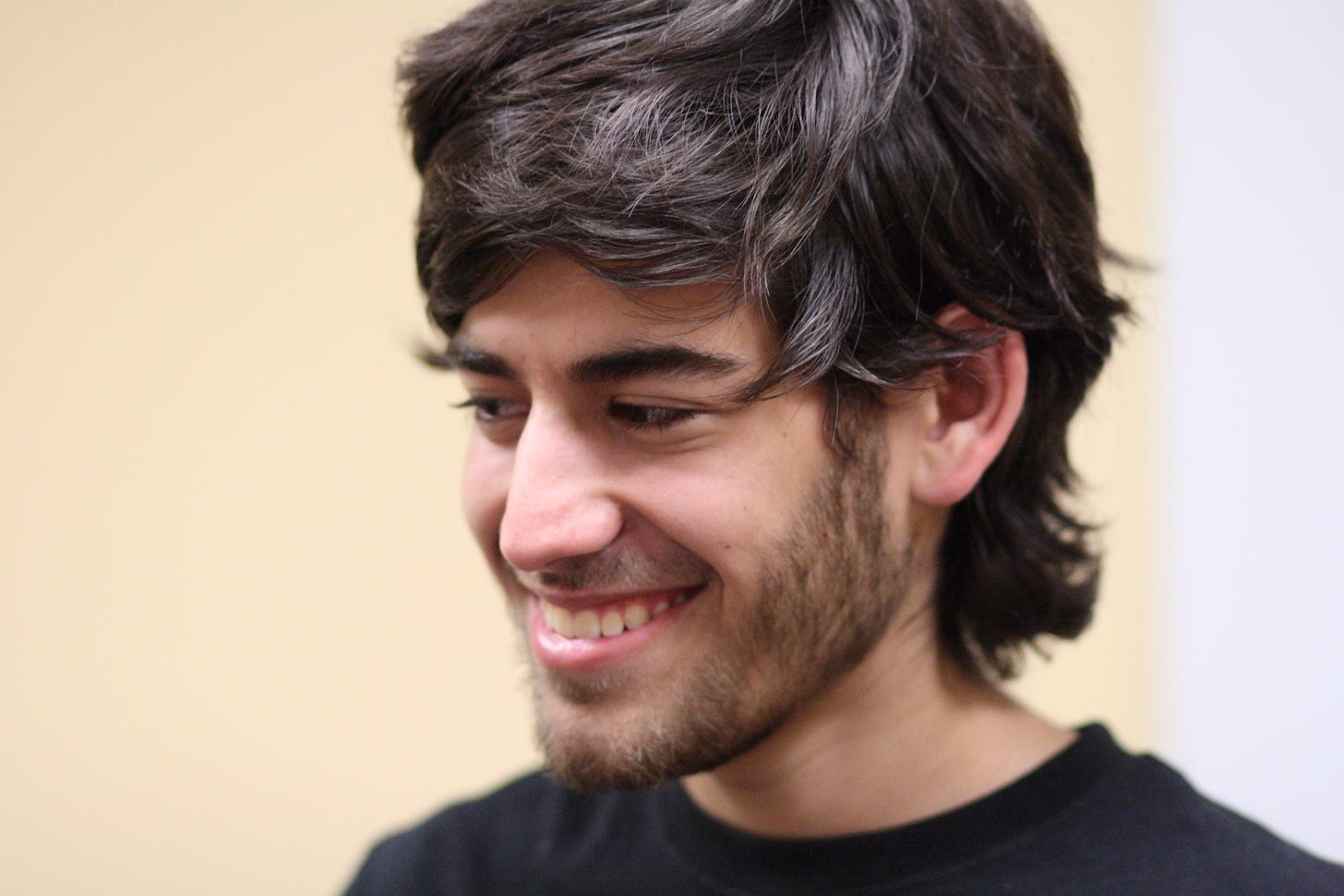
8 November would have been Aaron Swartz’s birthday. He was born in 1986 and left too soon, on 11 January 2013. Every time I think about him, I feel that hollow that unjust losses leave behind—the kind that arrive when a brilliant mind is crushed by a world that didn’t manage to understand it. Aaron was fragile and tenacious at the same time. Maybe it’s exactly that combination that makes him so human.
The teenage genius who changed the web
He had only a few years behind him when he started changing the way the web worked. At fourteen he took part in creating the RSS format, the technology that still powers blog and news feeds today. He wasn’t just a precocious programmer: he was someone who understood the transformative potential of technology.
He contributed to the birth of Creative Commons, the licensing system that lets creators around the world share their work without giving up their rights. He was a co-founder of Reddit, which over the years became one of the most influential communities on the internet. But he didn’t stop at technology: he founded Open Library to make books accessible to everyone, digitising thousands of volumes to build a universal, free library.
And then he wrote the Guerrilla Open Access Manifesto, a text that today reads almost like a love letter to freedom itself. In it, Aaron wrote words that still ring louder today:
“Information is power. But like all power, there are those who want to keep it for themselves. The world’s entire scientific and cultural heritage, published over centuries in books and journals, is increasingly being digitized and locked up by a handful of private corporations.”
Knowledge as a political act
Transparency and sharing sat at the centre of his thinking. Aaron believed that knowing was a political act, a right, a form of emancipation. He wasn’t naive: he understood that knowledge concentrated in the hands of a few is a tool of power and control. That’s why he fought to make it accessible to everyone.
He used to say that leaving a mark means breaking the rules, trying to change the system by doing what others don’t have the courage to do. A simple sentence, but one that gained immense weight over time. Because Aaron didn’t speak in slogans: he acted. And his actions had consequences.
In 2008 he uploaded and made freely available about 2.7 million federal court documents from PACER, a system that charged 8 cents a page for access to public documents. His logic was simple: if these are public documents, why do I have to pay to read them? He wasn’t prosecuted for that gesture, but he started being watched.
The persecution
Then came the darkest part of his story. In 2011 he was charged with downloading millions of scientific articles from JSTOR, a paywalled academic archive. He did it from MIT, using a connection on the university network. His goal, presumably, was to make publicly funded scientific research—locked behind prohibitive paywalls—available to the public.
The federal charges were devastating: thirteen counts, with sentences reaching 35 years in prison and a million-dollar fine. Thirteen counts for downloading academic articles. JSTOR itself decided not to pursue him, but the federal government kept going.
It was persecution more than prosecution. Federal prosecutor Carmen Ortiz wanted to make an example out of him, turn him into the symbol of the fight against “computer crime”. But Aaron wasn’t a criminal: he was an activist, an idealist, someone who believed that knowledge should be free.
The pressure became unbearable. Aaron suffered from depression, and the weight of the charges, the prospect of years in prison, the public pillorying, were too much. I often wonder whether it was really inevitable—whether the law, the very law that’s supposed to protect, can sometimes turn into a weapon against people seeking the truth.
On 11 January 2013, Aaron Swartz took his own life. He was 26 years old.
A legacy that keeps germinating
The other day, on what would have been his birthday, his legacy is more alive than ever. It lives in the open-access movements, in the people fighting to make publicly funded scientific research accessible to all. It lives in projects like Sci-Hub, which Alexandra Elbakyan created precisely as an answer to Aaron’s ideals.
It lives in digital-transparency projects, in the people working for a web that’s actually free, civil, fair. It lives in those who code not just to create but to give something back to the world. It lives in every developer who picks an open-source licence, in every researcher who publishes on open archives, in every activist who believes information has to be a right, not a privilege.
It’s as if Aaron planted a seed that keeps germinating, every time someone decides to share knowledge instead of hoarding it. Every time someone chooses transparency over secrecy. Every time someone stands against unjust systems that turn knowledge into merchandise.
The best way to remember him
After his death, the reactions were strong. Tim Berners-Lee, the inventor of the World Wide Web, tweeted: “Aaron is dead. The criminals are those who locked up knowledge and persecuted him. Let us wake up.”
Lawrence Lessig, co-founder of Creative Commons and Aaron’s mentor, wrote: “We’ve lost a friend. We’ve lost a fighter. America has lost an extraordinary figure.”
And Reddit’s co-founder Steve Huffman said: “Aaron wasn’t just a brilliant hacker and political activist. He was also my friend.”
But maybe the best way to remember him is exactly this: do what others don’t try to do. Defy the fear, the bureaucracy, the indifference. Continue his work, each in their own way, with the same courage as those who believe freedom and knowledge are never a privilege but a right.
You can do it in your own small way:
-
Use and support open source projects. Contribute when you can, even just with documentation or bug reports.
-
Share knowledge. If you have skills, teach them. If you have access to resources, make them available.
-
Choose open licences for your work, when possible. Creative Commons for content, MIT or GPL for code.
-
Support open access. If you’re a researcher, publish on open archives. If you’re a student, use and promote free alternatives.
-
Fight against unjust paywalls. Sign petitions, support organisations working for free access to knowledge.
“Guerrilla Open Access Manifesto”
I’d like to close with Aaron’s own words, from his 2008 manifesto:
“There is no justice in following unjust laws. It’s time to come into the light and, in the grand tradition of civil disobedience, declare our opposition to this private theft of public culture. We need to take information, wherever it is stored, make our copies and share them with the world. We need to take stuff that’s out of copyright and add it to the archive. We need to buy secret databases and put them on the web. We need to download scientific journals and upload them to file-sharing networks. We need to fight for Guerrilla Open Access.”
Strong words, radical, inconvenient. But necessary. Because Aaron taught us that change doesn’t arrive by waiting for someone to grant it from above. It arrives when brave people decide to act, despite the risks, despite the consequences.
Today Aaron would be 39. Who knows what he would have built, what he would have changed, what battles he would have fought in the era of AI, social media, fake news. But even though he isn’t here anymore, his spirit goes on living in every act of sharing, in every quiet rebellion against systems that want to privatise knowledge.
Happy birthday, Aaron. Your dream of a free web is still alive. And we’ll keep fighting to make it real.