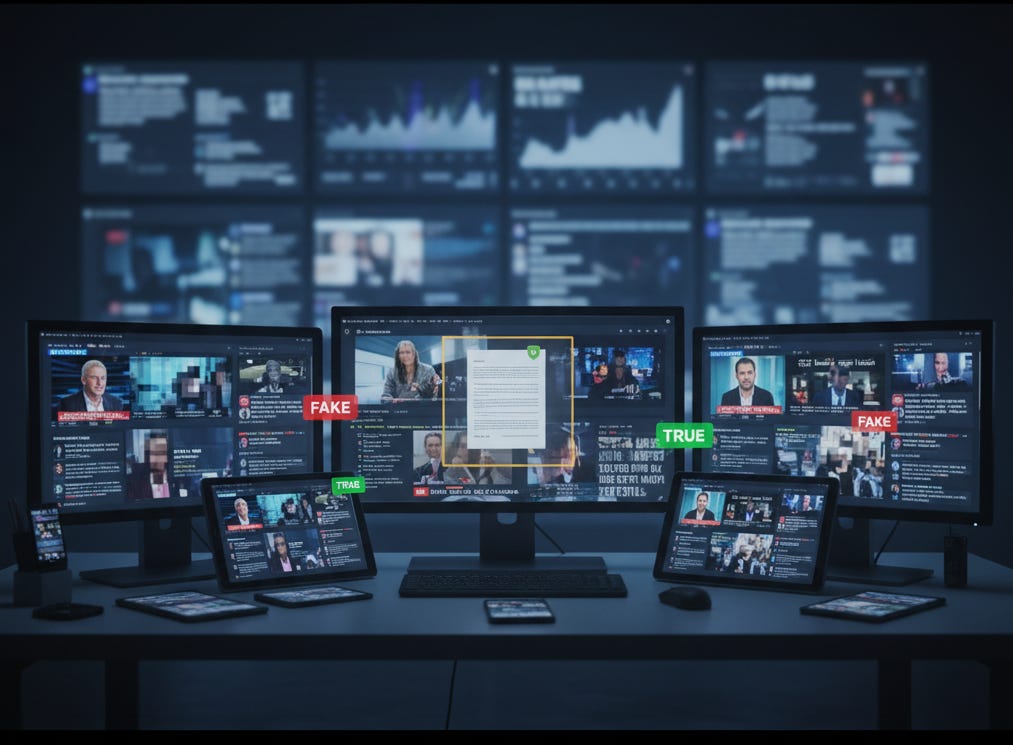
There’s a precise moment I realised something had broken in my relationship with knowledge. I was watching a video on YouTube, an interview with a politician saying things that struck me as absurd. I thought: must be a deepfake. Then I stopped. I had no real reason to think it, no visual glitch, no anomaly in the lip-sync. The doubt had simply become my default reaction. And that, I realised, changes everything.
I studied philosophy for years before turning to computer science, and that combination has always made me feel astride two worlds that struggle to talk to each other. On one side the Western epistemological tradition, with its obsession for the correspondence between thought and reality, that adaequatio rei et intellectus of Thomas Aquinas that still echoes in our most basic intuitions about what it means for something to be true. On the other side the world of algorithms, statistical patterns, neural networks producing texts and images indistinguishable from human ones without the slightest idea of what they’re doing. Two different languages, two different ontologies, and maybe two different eras that have ended up cohabiting in the same historical moment.
The Liar’s Dividend
What worries me most isn’t that deepfakes exist. It’s that their mere existence has changed how I look at everything else. Scholars call it the “liar’s dividend”: even without creating a single fake video, deepfake technology lets anyone discredit any authentic evidence simply by saying “it must have been AI-generated”. It’s brilliant, in a perverse way. You don’t need to substitute one truth for another. You just need to create enough noise to make every certainty impossible.
I often wonder whether postmodernism prepared us for this or only made us more vulnerable. Lyotard proclaimed the end of grand narratives in 1979; Nietzsche, a century earlier, talked about truths as “illusions whose illusory nature has been forgotten”. There was something liberating in that critique, a way to unmask the power hiding behind claims to objectivity. But now I wonder whether we haven’t demolished the tools we’d need to distinguish deliberate disinformation from legitimate plurality of interpretation. It’s a thought that makes me uncomfortable, because it sounds reactionary, and I don’t think I am. But the discomfort is maybe the signal that there’s something to understand.
When I read that in 2023 nearly a hundred thousand deepfake videos were detected, with a 550% increase since 2019, when I find out that today you can manipulate a video call in real time at a cost below two euros, I realise we’ve entered a territory where our epistemological intuitions no longer work. For millennia we took for granted that seeing was believing, that a photograph was evidence, that a video showed reality. All this is over, and I’m not sure we’re truly aware of it.
Algorithms and Filter Bubbles
There’s a phrase by Walter Quattrociocchi that stuck with me: “in the era of platforms and artificial intelligence, truth is no longer objective but shaped by the algorithm”. The first time I read it, it sounded exaggerated, almost a rhetorical provocation. But the more I think about it, the more it sounds like an accurate description of what we’re living. Recommendation algorithms aren’t neutral instruments showing us relevant information. They’re active agents in constructing our perceived reality. They decide what we see, in which order, with what frequency. And they do so optimising engagement metrics, not truth.
The result is what Eli Pariser called filter bubbles, places where we see only content consistent with our pre-existing beliefs. And echo chambers, places where our opinions get amplified and reinforced by people who think like us. Research on Twitter during the pandemic showed that users with right-wing political orientations formed particularly dense echo chambers, with 80% of their audience composed of similar people. But it isn’t only a problem of the political right. It’s a structural problem, inherent in the very architecture of platforms.
What strikes me is how invisible this process is to those it affects. No one tells you “you’re entering a bubble”. Your feed simply populates with content you like, opinions you share, people who think like you. And you think you’re seeing the world, when actually you’re seeing an increasingly distorted reflection of yourself.
Post-Truth and Common Ground
I’ve spent a lot of time thinking about the concept of “post-truth”, that word the Oxford Dictionary chose as word of the year in 2016. The official definition speaks of a condition where “objective facts are less influential in shaping public opinion than appeals to emotion and personal beliefs”. But it feels like something is missing. It isn’t only that emotions count more than facts. It’s that the very concept of “fact” has become contestable, that the possibility of a common ground on which to build disagreement has eroded.
Maybe this is what frightens me most. A democracy can survive disagreement—in fact, it needs it. But can it survive when there’s no longer agreement even on what counts as a fact? When every claim can be dismissed as fake news, every piece of evidence as manipulation, every expert as part of a conspiracy?
I often think about the COVID-19 pandemic as a large-scale natural experiment. We had a real virus, with real consequences, and a scientific system trying to understand it in real time, with all the limits and uncertainties that implies. And we saw how the digital information ecosystem amplified the confusion, turning legitimate scientific uncertainty into material for conspiracy theories, creating polarisation even on questions that should have united us. The World Health Organization coined the term “infodemic” to describe that overabundance of information, some accurate and some not, that made it hard for people to find their bearings. But maybe the term understates the problem. It wasn’t just too much information. It was an ecosystem designed to reward engagement over truth, polarisation over understanding.
Confirmation bias is as old as humanity. We tend to look for, interpret, and remember information that confirms what we already believe. But algorithms have transformed a psychological tendency into a technological architecture. They’ve automated confirmation bias, industrialised it. And so what used to be a cognitive defect to correct has become a business model to optimise.
The speed at which fake news spreads compared to verified information strikes me. An MIT study showed false news on X propagates six times faster than true news. It’s no accident. Fake news is designed to be emotionally engaging, sensational, polarising. It leverages our instinctive reactions, the brain centres that respond before the prefrontal cortex has time to analyse critically. It’s a form of cognitive hacking, and it works because it exploits the same vulnerabilities that let us survive as a species.
LLMs and the End of Truth as State
What fascinates me, in a disturbing way, is how AI is changing not only the quantity but the quality of possible disinformation. Large language models like GPT don’t know what’s true. They have no access to an external reality to verify. They’re statistical machines predicting which word comes after another, based on patterns learned from billions of human texts. But the result is so convincing, so fluid, so apparently reasoned, that it’s incredibly easy to forget what’s actually happening under the hood.
A philosopher I read recently asked a question that made me think for a long time: “what does it mean for a system to ‘know’ something if it has no awareness or intentionality?” It’s a question that touches the heart of what we’ve always thought knowledge was. For Plato, knowledge was justified true belief. But can there be belief without a subject who believes? Can there be justification without understanding? Are we maybe witnessing the emergence of a purely inferential, functional, statistical “knowledge”—without that link to the world that Western philosophy has always considered essential?
I have no answers, only questions. But maybe that’s right. Maybe at this moment questions are more important than answers.
Onlife and Cognitive Hybridisation
There’s a concept Luciano Floridi introduced that helps me think about our condition: “onlife”. The idea is that the boundaries between online and offline, digital and physical, real and virtual are dissolving. We no longer live in the physical world with occasional excursions into the digital. We live in a hybrid space where the two dimensions interpenetrate. And this changes not only how we know but who we are.
I recognise myself in this description. My digital self isn’t a mask I wear when I go online. It’s part of me, a part that interacts with algorithms, expresses itself through avatars, delegates portions of its identity to profiles on platforms I don’t control. It’s a form of hybridisation my grandparents would probably have struggled to understand, but for me it’s simply normal. And that makes me think how quickly we adapt to changes that, viewed from a certain distance, are radical.
Hybridisation isn’t only digital. Millions of people live with pacemakers, prostheses, implants. Our evolution toward the cyborg is already under way, and is much less science-fictional than we imagine. But while physical hybridisation has generally been welcomed as medical progress, cognitive hybridisation produces more ambivalence. Maybe because it touches something more intimate, something we consider the core of our being: thought, reason, the capacity to know.
What worries me isn’t hybridisation itself. It’s the possibility that we’re delegating too much to machines without understanding what we’re losing. There’s a quote from Hannah Arendt that has haunted me since I read it:
If knowledge were irrevocably separated from thought, then we would become hopeless beings, slaves not so much of our machines as of our competence, thoughtless creatures at the mercy of every technically possible device.
Arendt was writing in the 1960s, long before the internet, before social media, before generative AI. But her words seem to describe a risk much more concrete today than it was then.
Studies on digital natives show worrying tendencies: superficial information processing, rapid attention shifting, reduced capacities for prolonged reflection. It isn’t a moral condemnation, it’s a description of how our brains are adapting to an information environment designed to capture attention rather than feed understanding. And I wonder if we’re creating the conditions for that separation between knowledge and thought Arendt talked about.
But maybe I’m too pessimistic. Maybe every generation has thought the next was losing something essential, and every time history has refuted that pessimism. Or maybe this time it’s different. I don’t know. Intellectual honesty makes me admit I don’t know.
Trust and the Limits of Media Literacy
What I do know is that one result of all this is that the data on trust in institutions is alarming. In Italy trust in the institutional system is below the European average. Only one citizen in five says they trust political parties. Trust in Parliament sits at 37%, in parties at 24%. Even the Presidency of the Republic, traditionally the most respected institution, recorded a significant drop. They aren’t abstract numbers. They’re the sign of a fracture between society and institutions that makes any collective challenge harder, from ecological transition to digital transition.
Trust in traditional media has followed a similar trajectory. And this creates a vicious circle: less trust in media means more vulnerability to disinformation, which in turn further erodes trust. It’s a self-reinforcing system, and I don’t see how it can stabilise without structural intervention.
The European Union tried to respond with the AI Act, a regulation introducing transparency obligations for AI-generated content, including deepfakes. The idea is simple: if you can’t prevent the creation of synthetic content, at least you can require those who produce it to label it as such. But I wonder how much it can work in practice. Anyone deliberately creating disinformation won’t be stopped by a labelling requirement. And those consuming it often don’t want to be undeceived.
Media literacy gets often cited as the educational answer to the problem. Teach people to verify sources, recognise the signs of disinformation, resist confirmation bias. It’s a noble goal, and certainly necessary. But I wonder if it’s enough. Cognitive biases aren’t errors that get corrected by education. They’re mental shortcuts deeply rooted in our cognitive architecture. And algorithms are designed by some of the brightest minds on the planet precisely to exploit them. It’s an asymmetric arms race, and I’m not sure education can win it alone.
Maybe the most important thing is to recognise we aren’t facing a technical problem requiring a technical solution. We’re facing an anthropological transformation requiring a deep rethink of what knowing, communicating, trusting mean. It isn’t something solved by an app or a training course. It’s something that requires long-term cultural work, a collective renegotiation of what we consider true and how we come to consider it so.
Truth as a Process
There’s a proposal that strikes me as promising, even if I don’t know how realistic: shifting from a conception of truth as state to a conception of truth as process. No longer something one possesses or discovers once and for all, but something built continuously through validation, verification, comparison, revision. Not a relativism where everything counts equally, but a critical realism that recognises both the existence of an independent reality and the mediated, partial, contextual nature of our knowledge of it.
It’s a hard balance to maintain. On one side there’s the risk of a naive objectivism that ignores how much our conceptual categories influence what we see. On the other there’s the risk of a relativism that dissolves any criterion of distinction between reliable information and disinformation. Finding the middle path requires a form of epistemological wisdom we may still need to learn how to cultivate.
Quattrociocchi wrote something that captures this idea well:
The truth of the future won’t be a fixed point, but a process of continuous validation, in which data and knowledge are built more transparently and verifiably.
I like this formulation, even if I don’t know how realistic it is. But maybe that’s exactly the point: we don’t know what’s realistic because we’re in the middle of a transformation whose outcomes aren’t yet determined. We can still influence them, if we choose to.
When I think back to that video that made me suspect a deepfake, I realise the problem wasn’t the video itself. The problem was that doubt had become my default state. I lost something I didn’t even know I had: a basic trust in the possibility of distinguishing the real from the fake, the actual from the artefact. And I wonder how many other people are living the same thing, maybe without even realising.
I don’t know what the road out of this condition is. I don’t think there’s a simple solution, an intervention that fixes everything. But I think the first step is becoming aware of where we are, of the depth of the transformation under way, of what’s at stake. And then, maybe, trying to build something different together. Not return to a past that can’t return, but imagine a future where truth is neither an untouchable idol nor an illusion to abandon, but a collective project to take part in.
The alternative—what someone has called “hypnocracy”, a regime of cognitive control through algorithmic manipulation—seems to me much worse.
And we should try and fail rather than not try at all.
And maybe this, in the end, is the only way to stay human in an era when humanity itself is being put into question. Don’t surrender to cynicism, don’t yield to despair, but keep searching, doubting, asking. Even when the answers don’t come. Especially when the answers don’t come.
Key takeaways
The liar’s dividend: you don’t need to create a fake—it’s enough to be able to say “it must have been generated by AI” to discredit any authentic evidence.
Media literacy isn’t enough: cognitive biases don’t get corrected by education, and algorithms are designed by some of the brightest minds precisely to exploit them.
It isn’t a technical problem requiring a technical solution; it’s an anthropological transformation requiring us to renegotiate what we consider true.
The author